
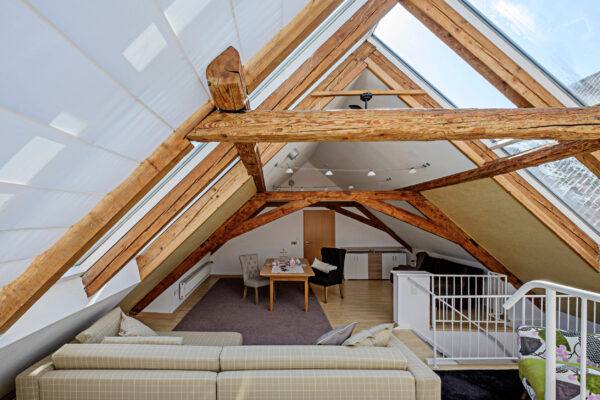
When converting roofs in old buildings, there is a risk of wood preservatives being contaminated by toxic paints, which are now banned. These highly contaminated wood preservatives were not only used in the roof area and for the exterior. They are not only used in the rooms for which they were intended, but also indoors to paint beams, wooden floors, wooden panels or cladding. They are particularly dangerous to the health of the occupants as they can continue to emit pollutants for decades.
Use of wood preservatives today
Appropriate wood preservation is important for the protection and conservation of wood. Nowadays, it should be as gentle as possible and as effective as necessary to protect health and the environment. Wood preservatives with biocides are used to protect against infestation by wood-destroying insects, fungi and wood-discoloring organisms.
Chemical wood preservatives may only be used in certain areas such as load-bearing components in accordance with DIN 68800. They are suitable for outdoor use and must not be used in living areas. It is recommended to use structural wood protection measures and alternative methods instead of wood preservatives. In this way, high health risks for residents and environmental pollution can be avoided.
Old wood preservatives hardly noticeable
Just a few decades ago wood preservatives mostly consisted of highly toxic chemicals that could continue to outgas for years after their application. They often remain unnoticed for many years and can cause serious long-term damage to health. In many old buildings, despite being intended for outdoor use, wooden furniture, doors, ceilings and other areas of living spaces were also treated with toxic products. Very often, these toxic wood preservatives were also used for roof trusses. In most cases, this involved the product Xylamon.
Dangerously long unnoticed evaporation of old wood preservatives
In old attics, which are often well ventilated, the toxic wood preservatives are hardly or no longer perceptible. They become more noticeable after the roof has been insulated, as the renovated rooms are now less ventilated and unpleasant to pungent odors have developed in the converted attic apartment. Visible indications in old roof trusses or other treated wood areas can be crystalline efflorescence on the surfaces previously painted with wood preservative paints. These are often recognizable as white-yellowish, fine crumbly dust.
Professional dust sampling or wood sampling should be carried out to clearly determine the presence of pollutants before a roof extension for residential purposes or indoors.
Wood preservatives in the 1960s and 1970s in the former Federal Republic of Germany
Wood preservatives used in the 1960s and 1970s in particular were heavily contaminated with dangerous and harmful ingredients, especially combinations of biocides against insects and other wood pests. They often contained the active ingredient pentachlorophenol (PCP), frequently in combination with lindane as an insecticide.
PCP is classified as probably carcinogenic and harmful to development in Germany according to hazardous substances legislation. It is also suspected that PCP may be mutagenic.
The insecticide lindane is harmful to the human nervous system. However, lindane can be more easily excreted from the body. Lindane was withdrawn from the market by 01.09.2006. Due to contamination, other pollutants such as polychlorinated dibenzodioxins and -furans (PCDD/F) were also found in the old wood preservatives.
Wood preservation in the former GDR
During the GDR era, roof trusses were extensively painted with the DDT-containing wood preservative “Hylotox 59“. It contained a mixture of about 30 grams of DDT and about 5 grams of lindane per liter. Even decades after these woods were treated with this agent, tests of wood chips revealed around 1,000 milligrams of DDT per kilogram of material.
Another wood preservative that was also used in East Germany during the GDR era was “Hylotox IP“, which was often used to treat roof trusses and other load-bearing wooden structures. It contained a mixture of PCP and DDT. This wood preservative was also frequently used indoors until the fall of communism, although it was banned for this purpose. In a test, Stiftung Warentest found that these highly toxic agents were also used in living areasin around one in ten samples. Even decades after the wood treatment, the toxic substances can still be detected in samples of material, indoor air and dust analyses.
Exposure to wood preservatives after insulation and damping
After extensive insulation measures such as thermal insulation on windows, ceilings and walls, the exchange of air in rooms is more restricted. Roof conversions in old buildings for residential purposes and insulation in roof trusses also mean that the roof is less ventilated. Before these insulation measures, there was much more air exchange through joints and cracks, which meant that pollutants were better ventilated away. After insulation, however, the risk of health hazards increases due to the biocides released from old wood preservative coatings.
The pollutants can be released directly into the interior after a roof conversion or, for example, through old paintwork on half-timbered house. They can evaporate into the indoor air in dangerously high and unhealthy concentrations for decades, accumulate in house dust and be inhaled.
Measures in the event of suspected hazardous pollutants such as PCP in wood preservatives
If pollutants are suspected, appropriate investigations should be carried out due to the high health risks. Further measures such as airtight encapsulation and cladding with old roof beams that have been treated with wood preservative can also be useful.
The PCP guideline (Guideline for the assessment and remediation of pentachlorophenol (PCP)-contaminated building materials and components in buildings, Ministerial Gazette NRW 1997 p. 1058) sets out requirements for determining the need for remediation of PCP-contaminated rooms and provides suggestions for suitable remediation.
Health effects of wood preservatives
The health effects of the biocides PCP and lindane, which were often contained in wood preservatives, vary. These toxins can cause various diseases. The long-term effects range from minor complaints to serious illnesses. These range from acne, fatigue, headaches, concentration and sleep disorders, cramps, susceptibility to infections, motor impairments, nerve and organ damage to cancer.
Ban on the use of wood preservatives containing PCP
In 1989, the use of PCP-containing wood preservatives indoors was banned by the Hazardous Substances Ordinance. PCP and products containing PCP (>0.01 % PCP) and wooden parts with more than 5 mg PCP/kg in the wood surface may no longer be placed on the market and may not be used.
Legal provisions for wood preservatives
The review of the active ingredients of wood preservatives for their effects on human health and the environment has applied since the introduction of the European Biocides Directive 98/8/EC and the further Biocides Regulation (EU) 528/2012. Only active ingredients that are safe and at the same time sufficiently effective may continue to be used in products.
The DIN 68800 regulates the use of wood preservatives. Chemical wood preservatives are prescribed for wood used for load-bearing and bracing purposes. The Federal Institute for Materials Research and Testing (BAM) tests these agents for their use as wood preservatives. Wood preservatives must be approved by the German Institute for Building Technology (DIBt). The products available on the market must bear the RAL-GZ 830 quality mark quality mark.
Wood preservatives – measure PCP and lindane with PM4-2
The GSA PM4-2 measuring device is suitable for sampling the pollutants PCP and lindane in indoor air. This measuring device can be used, for example, to measure concentrations of releases of the pollutants PCP and lindane in indoor air that originate from old and toxic wood coatings, for example.
Special air measurements such as the simultaneous sampling of particulate and filterable components are required for the indoor air test for the pollutants PCP and lindane. The GSA measuring devices PM4-2 works with a high air flow rate. With a high air flow rate, sampling can also be carried out in smaller rooms, such as cabins. The PM4-2 measuring device can also be operated independently of the mains. We recommend our partner company, GSA Schadstoffanalytik, for analyzing the samples taken.
Sources:
Image source: 123rf.com ©riktam , image no. 169670058
www.de.wikipedia.org/wiki/Pentachlorphenol
www.de.wikipedia.org/wiki/Lindan
www.dbz.de/news/dbz_Giftige_Holzschutzmittel_Gesellschaft_fuer_Technische_ueberwachung_GT-1016338.html
www.innenraumluft.nrw.de/4_schadstoffe/pcp_holzschutzmittel.php
www.gesamtverband-schadstoff.de/76-1-pcp-lindan-und-ddt/
www.lfu.bayern.de/abfall/schadstoffratgeber_gebaeuderueckbau/suchregister/doc/507.pdf
www.test.de/Holzschutz-Altlasten-auf-der-Spur-4508463-0/
www.umweltbundesamt.de/holzschutzmittel#materialspezifizierung
www.umweltbundesamt.de/themen/chemikalien/persistente-organische-schadstoffe-pop/lindan-hch
www.umweltbundesamt.de/themen/chemikalien/persistente-organische-schadstoffe-pop/pentachlorphenol-seine-salze-ester-pcp
www.umweltbundesamt.de/themen/chemikalien/biozide/nachhaltiger-umgang-schadorganismen/nicht-biozide-substitution-von-bekaempfenden
www.wohnnet.at/bauen/innenausbau/wohngifte-14209