
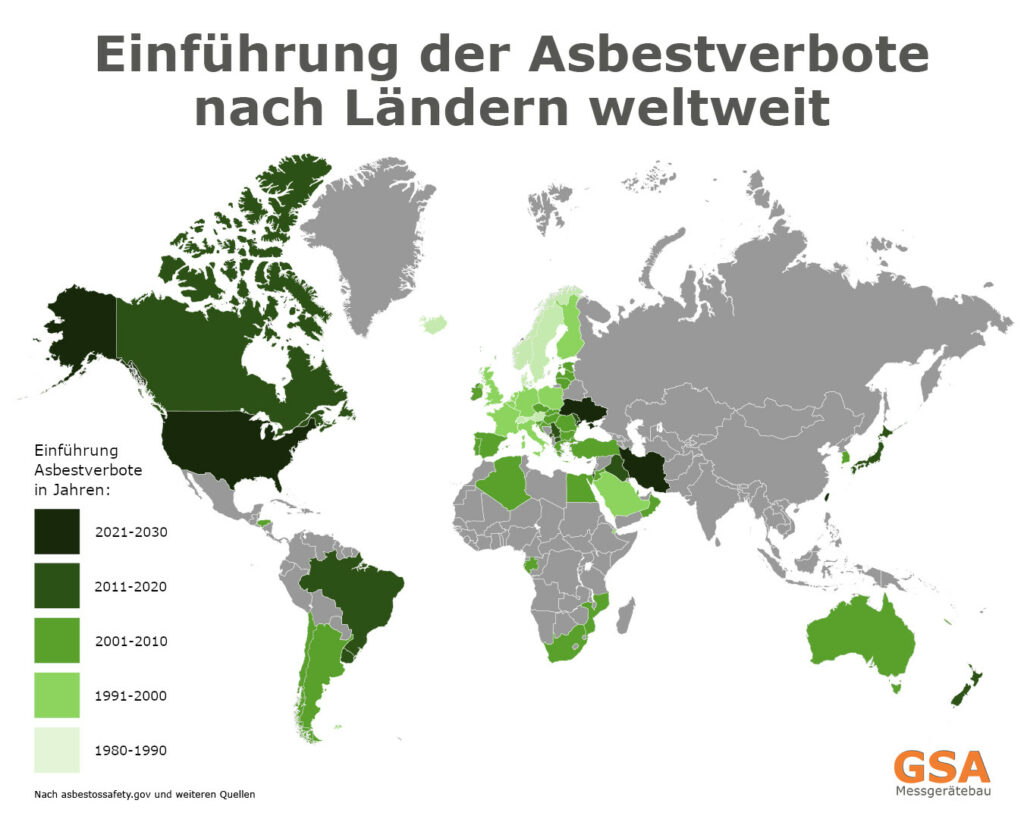
There is currently no comprehensive ban on asbestos worldwide. Individual countries, mainly in Northern Europe, first introduced asbestos bans in the 1980s. The mining, processing and use of products containing asbestos continues to be a serious problem for human health and the environment.
According to estimates (WHO 2018), around 125 million people work in workplaces with asbestos exposure. Furthermore, many thousands of people die every year from asbestos-related diseases, not all of which can be attributed to occupational exposure to asbestos.
Asbestos – naturally occurring silicate minerals
Asbest bildet eine Gruppe natürlich vorkommender faseriger Silikat-Minerale wie die Hauptformen Chrysotil oder Krokydolith. Asbestfasern galten jahrzehntelang als “Wunderfasern”. Sie sind besonders hitzebeständig und weisen eine nur geringe Wärmeleitung auf. Darüber hinaus sind sie widerstandsfähig gegenüber chemischen Einwirkungen und besitzen eine besonders hohe Festigkeit. Dies machte das industriell erzeugte asbesthaltige Material besonders geeignet für den Nutzen in der Bauindustrie, wo asbesthaltige Erzeugnisse für Dächer, Wasserleitungen und andere Produkte wie Kleber verwendet wurden. Auch im Kfz-Bereich wurden diese zur Produktion von Kupplungen, Bremsbelägen und -klötzen und insbesondere für den Schiffsbau eingesetzt. Darüber hinaus wurden Asbestfasern zu Garnen versponnen, aus denen bspw. hitzebeständige Arbeitsbekleidung hergestellt wurde.
Hazardous asbestos fibers
All types of asbestos are harmful to health if the asbestos fibers can be released and reach the alveoli of the lungs via the respiratory tract over long periods of time. There is a high risk from prolonged or years-long exposure to asbestos, which can lead to occupational diseases such as asbestosis.
Diseases caused by asbestos
Alle Arten von Asbest können Lungenkrebs, Mesotheliom, Kehlkopf- und Eierstockkrebs, Asbestose (Lungenfibrose) sowie Plaques, Verdickungen und Ergüsse im Rippenfell hervorrufen. Die gesundheitsgefährdende Asbestexposition erfolgt durch das Einatmen der Asbestfasern am Arbeitsplatz, in Bereichen, in denen Asbest verarbeitet wird oder bspw. in der Innenraumluft von Wohnungen. In Gebäuden können sich durch Alterung oder mechanische Arbeiten die Asbestfasern aus den asbesthaltigen verbauten Materialien freisetzen. Seit Jahrzehnten ist Asbestose als Berufskrankheit anerkannt. Obwohl das Asbestverbot bspw. in Deutschland seit 1993 gilt, kommt es immer noch zu zahlreichen Fällen an Asbestose-Erkrankungen wie in anderen Ländern, in denen ebenfalls das Verbot schon lange besteht. Der Grund liegt in der langen Latenzzeit der Erkrankung. Diese kann bis zu 30 Jahre betragen. So können heute Personen, die bis in die 90er-Jahre regelmäßig mit Asbest am Arbeitsplatz in Berührung kamen, noch heute an deren Spätfolgen leiden.
Mining of asbestos in asbestos mines
Die Gewinnung von Asbestfasern zur industriellen Nutzung erfolgt durch den Abbau in Asbestminen. In zahlreichen Ländern ist die Gewinnung der Asbestfasern in Minen bereits verboten. Dennoch bauen heutzutage weiterhin einige Länder wie China, Russland und Indien das asbesthaltige Gestein in ihren Asbestminen ab. Die Weiterverarbeitung des Asbestgesteins erfolgt in Asbestwerken, um Asbestfasern verschiedener Länge für industrielle Zwecke zu gewinnen.
Introduction of asbestos bans by country
A comprehensive ban on asbestos has been in force in the EU since 2005, which prohibits the manufacture, marketing or use of asbestos or products containing asbestos. It has been in force in Germany since 1993. Most industrialized countries also prohibit this.
According to the International Ban Asbestos Secretariat, the mining, manufacture and use of products containing asbestos are now banned in many countries. For some of these countries, certain special regulations apply for restricted uses.
In wenigen Ländern wie China, Russland, Indien gilt bisher noch kein striktes Asbestverbot, sondern weiterhin Ausnahmen, die insbesondere die Verwendung von Asbest erlauben. Weiterhin wird Asbest verwendet und mit seinen Fasern asbesthaltige Produkte hergestellt. In den Entwicklungs- und Schwellenländern existiert eine Asbestlobby gegen ein Verbot. Beispielsweise bildeten Asbestwerke aus Russland, Ukraine und Kasachstan 2006 eine Dachorganisation der Asbestzementarbeiter, die ein Asbestverbot stoppen will.
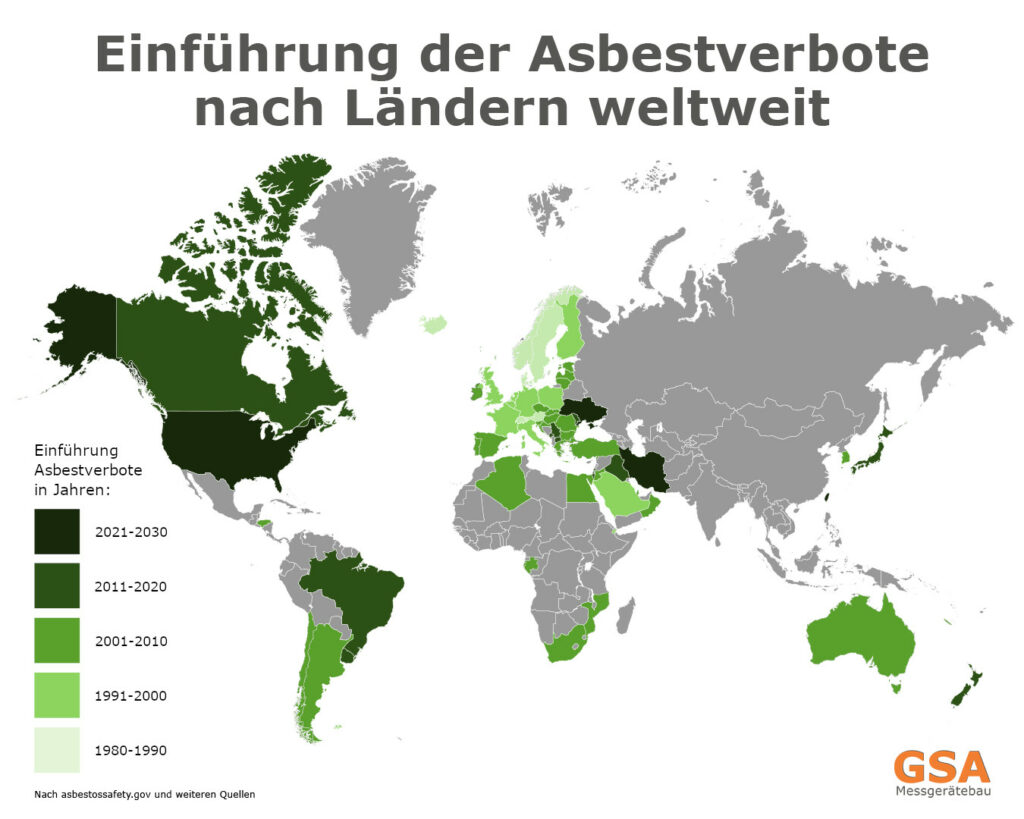
The graphical representation of the country-specific asbestos bans was created with the utmost care. Nevertheless, errors in content cannot be completely ruled out. The data sources used are listed below the article.
Asbestos bans introduced in the years 1980 -1990
- Denmark, Iceland, Norway, Austria, Sweden, Switzerland
Asbestos bans introduced in the years 1991 – 2000
- Bahrain, Belgium, Djibouti, France, Finland, Germany, Italy, Kuwait, Netherlands, Poland, Saudi Arabia, United Kingdom
Asbestos bans introduced in the years 2001 – 2010 (an asbestos ban has been in force throughout the EU since 2005)
- Egypt, Algeria, Argentina, Australia
- Bulgaria
- Chile
- Estonia
- Gabon, Greece
- Honduras
- Ireland
- Jordan
- Qatar, Croatia
- Latvia, Lithuania, Luxembourg
- Malta, Mozambique, Mauritius
- New Caledonia
- Oman
- Portugal
- Romania
- Seychelles, Slovenia, Spain, South Korea, South Africa
- Czech Republic, Turkey
- Hungary
Asbestos bans introduced in the years 2011 – 2020
- Brazil (some states)
- Iraq
- Israel
- Japan
- Canada
- North Macedonia
- Moldova
- New Zealand
- Serbia
- Uruguay
Asbestos bans introduced in the years 2021 – 2030
- Brazil (other states)
- Iran
- Taiwan
- Ukraine
- United States of America
In a few of the countries listed above, exceptions are permitted for minor uses of asbestos fibers. However, all countries must ban the use of all types of asbestos. Special exceptions apply, for example, to special seals. In some countries, asbestos brake linings are still permitted after a certain transitional period.
Working towards a global ban on asbestos – WHO and ISSA
The World Health Organization (WHO) and the International Social Security Association (ISSA) are the main advocates of a global ban on asbestos. In the 2004 Beijing Declaration, the ISSA’s Special Commission on Preventioncalled on all countries worldwide to ban the production, trade and use of all types of asbestos and asbestos-containing products. The WHO works with the International Labor Organization and other associations, civil society and countries to eliminate asbestos-related diseases. The WHO provides information on solutions for replacing asbestos with safer substitutes, on measures to prevent exposure to asbestos at the workplace or, for example, on asbestos removal. It is also committed to improving the treatment and early diagnosis of asbestos-related diseases, raising awareness of the dangers and correct handling of asbestos-containing materials. The ISSA’s Special Commission on Prevention has called on all countries to ban the production, trade and use of all types of asbestos and asbestos-containing products as soon as possible.
Asbestos measurement with GSA measuring devices SG12
If asbestos is suspected in the indoor air, the use of special measuring devices such as the GSA measuring devices SG12 is recommended for precise asbestos measurement.
Even very low concentrations of asbestos fibers in the room air can be sampled with the SG12. The SG12 asbestos measuring device developed in Germany is suitable for sampling inorganic fibrous particles in accordance with VDI 3492 and ISO 14966 as well as for asbestos or artificial mineral fibers. According to VDI 3492 , eight hours of sampling are sufficient. According to DGUV 213-546, a measurement at the workplace is possible within two hours. The measuring device can also be used to measure the various dust fractions such as A-dust or E-dust.
Sampling for possible asbestos contamination is particularly useful when renovating and purchasing apartments and buildings, as material containing asbestos was allowed to be processed and used in Germany in the post-war period until around 1993.
Who carries out asbestos measurements on site at the workplace and in a private household?
Our sister company has over 30 years of experience in asbestos measurements on site. They will also carry out the associated analysis and advice for you. Here you will receive competent help – even without prior knowledge or your own equipment.
Sources:
Image source: 123rf.com ©slavastan Image no. 1117380
www.analyticalscience.wiley.com/do/10.1002/gitfach.17487
www.asbest-sanierungen.com/2020/07/wann-wurde-asbest-verboten-deutschland-schweiz-oesterreich-eu/
www.anstageslicht.de/themen/gesundheit/asbest-ein-krimi-mit-millionen-von-toten-seit-120-jahren-bis-heute/warum-es-so-lange-gedauert-hat-bis-asbest-verboten-wurde-die-darauffolgenden-50-jahre/
www.asbestosnation.org/facts/asbestos-bans-around-the-world/
www.asbestossafety.gov.au/importing-advice/countries-asbestos-bans
www.bgbau.de/themen/sicherheit-und-gesundheit/asbest/vom-wunderstoff-zum-albtraum-haeufige-fragen-zu-asbest
www.edition.cnn.com/2024/03/18/health/epa-bans-last-form-of-asbestos-used-in-united-states/index.html
www.ibasecretariat.org/alpha_ban_list.php
www.who.int/teams/environment-climate-change-and-health/chemical-safety-and-health/health-impacts/chemicals/asbestos
ww1.issa.int/en/node/20311 (Beijing 2004 Asbestos Ban Declaration)
wwww.pubs.usgs.gov/periodicals/mcs2023/mcs2023-asbestos.pdf (USA published 2023)
www.umweltbundesamt.de/themen/gesundheit/umwelteinfluesse-auf-den-menschen/chemische-stoffe/asbest#wo-finde-ich-rat-und-hilfe-bei-asbest-im-wohnumfeld-oder-am-arbeitsplatz
www.spiegel.de/panorama/justiz/asbest-prozess-in-italien-zwei-angeklagte-muessen-fuer-16-jahre-ins-gefaengnis-a-815075.html
www.unia.ch/de/arbeitswelt/von-a-z/asbest/30-jahre-asbestverbot (here, asbestos is banned in 69 countries)
www.de.wikipedia.org/wiki/Asbest
www.wochenblatt.es/spanien/hoechstes-schmerzensgeld-fuer-asbest-opfer/?v=3a52f3c22ed6