
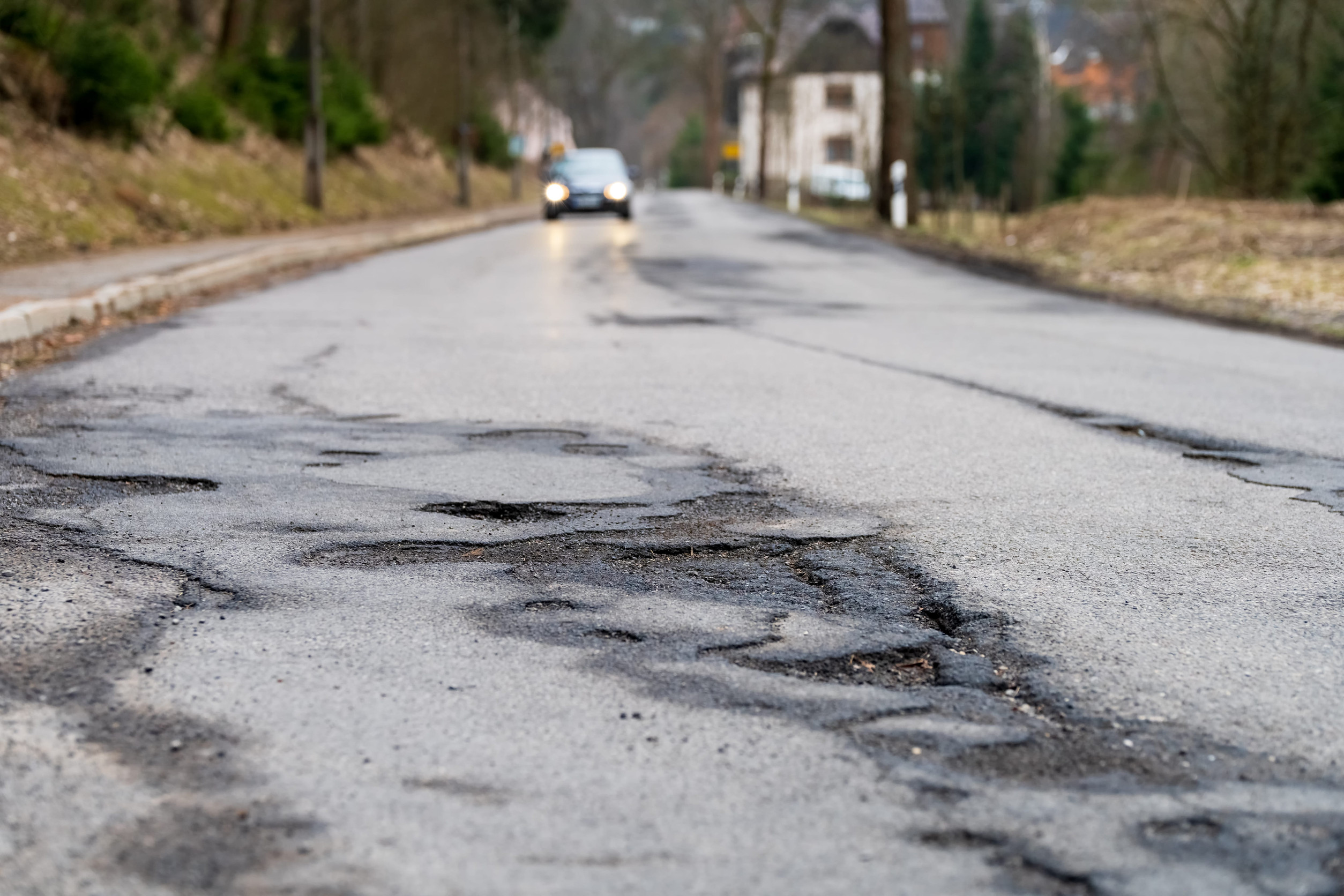
Asphalt road surfaces are an often-underestimated source of pollutants during the summer months. Particularly high temperatures and UV radiation cause asphalt surfaces to age more quickly. More frequent heat waves and the urban heat island effect are likely to further exacerbate this situation in the coming years.
Asphalt pavement
Asphalt consists of rock and bitumen, a petroleum product containing numerous organic compounds. At normal temperatures, these substances are firmly bound within the asphalt. In the summer, however, asphalt surfaces can quickly reach temperatures of 60 to 70°C. On dark roads, parking lots, or sidewalks, temperatures can reach even higher levels.
Common pollutants in asphalt
Depending on the binder used in the asphalt, it may contain varying amounts of pollutants. For example, it may contain polycyclic aromatic hydrocarbons (PAHs). Large amounts of PAHs are found particularly in old pavements containing tar. Modern bitumen has significantly lower PAH levels.
Bitumen also poses an emission risk. For example, volatile organic compounds (VOCs) are produced through the evaporation of highly volatile bitumen components or through the degradation of bitumen at high temperatures. Temperatures ranging from 60 to 70 °C cause the bitumen binder to soften. This leads to increased release of the volatile organic compounds it contains into the ambient air.
Polycyclic aromatic hydrocarbons (PAHs)
PAHs are the best-known group of pollutants in bitumen and asphalt. These include benzo[a]pyrene. The IARC classifies occupational exposure to distillation bitumen and its emissions during road construction as possibly carcinogenic.
PAHs are released in both gaseous and particulate forms when exposed to heat. This can also affect old floor coverings that are already damaged, softened, or cracked. For benzo(a)pyrene, the target value for outdoor air is 1 ng/m³ as an annual average. In Germany, this target value is generally met. Isolated instances of exceedances have been observed, particularly in the vicinity of industrial sources.
Volatile organic compounds (VOCs)
Bitumen also contains a number of volatile organic compounds (VOCs). These include benzene, toluene, xylenes, and various aliphatic compounds. Especially around cracks, the VOCs evaporate directly into the air near the ground when exposed to heat. At cracks and broken areas, the bitumen binder comes to the surface more prominently.
Bitumen fumes
Bitumen fumes are a mixture of gaseous compounds and extremely fine droplets. They are primarily generated when bitumen is heated at construction sites. The IARC classifies them as “probably carcinogenic to humans” in an occupational setting. They remain a risk near construction sites or in large, poorly ventilated, and extremely hot work areas.
Fine dust
Volatile organic compounds from the bitumen-aggregate mixture partially convert into fine dust in the air, which can pose health risks. In laboratory tests, simulated solar radiation significantly increased organic emissions, under certain test conditions, to about three times the original level.
Fine particulate matter (PM2.5 and PM10) can be released from old pavement that has softened or been subjected to mechanical stress. These particles are generated, for example, by tire abrasion on softened asphalt or by the breaking off of pavement fragments at cracks and potholes. These particles then release bound PAHs and other pollutants into the air we breathe.
Damaged old flooring releases more pollutants
Heat and intense sunlight
Heat and direct sunlight have a particularly intense effect on asphalt. The dark surface absorbs large amounts of radiation and heats up to temperatures far exceeding the air temperature. At the same time, UV light accelerates the aging of the bitumen. The surface becomes more brittle, cracks form more quickly, and pollutants can escape more easily. In calm weather, these pollutants accumulate in the air near the ground.
High humidity
High humidity also leads to the release of volatile substances. In muggy weather, water molecules adhere to the asphalt surface and alter the physical properties of the bitumen. VOC emissions can increase significantly at high humidity and temperatures around 50 °C. Moist air acts as an additional catalyst that facilitates the release of volatile compounds.
Urban heat island effect
In cities, the urban heat island effect is an additional factor contributing to asphalt damage and related emissions. Densely built-up areas and large asphalt surfaces store heat and release it only slowly. As a result, streets, paths, and parking lots remain hot for longer periods and more frequently reach critically high temperatures. This can lead to a greater accumulation of pollutants, particularly in courtyards, along building edges, or on large traffic areas.
People affected by pollutants in asphalt
Employees in road construction and civil engineering
Workers who come into direct contact with hot asphalt are most at risk. This group includes, for example, road builders, roller operators, and paving machine operators. The Institut für Arbeitsschutz of the German Social Accident Insurance (IFA) has conducted extensive studies on the exposure of these occupational groups. They found that contact through the skin is often more harmful than inhalation.
Outside of road construction, those most affected are people who work daily on large, heated asphalt surfaces without coming into direct contact with fresh asphalt. This group includes, in particular, forklift operators at outdoor warehouses, security personnel at entrances, service employees involved in delivery operations, and workers at maintenance depots. During prolonged exposure, an increased risk cannot be ruled out. The actual level of exposure can only be assessed through appropriate sampling and analysis.
Have asphalt contaminants professionally tested
Whether hot asphalt surfaces pose a significant occupational hazard cannot be determined solely on the basis of surface temperature or the condition of the pavement. The decisive factors are the actual concentrations present in the air we breathe, as well as the duration and nature of exposure.
The GSA Gesellschaft für Schadstoffanalytik supports companies in the planning,
implementation, and evaluation of appropriate air measurements. Depending on the specific issue, personal or stationary measurements of benzo(a)pyrene and other low-volatility PAHs in accordance with IFA 8408, as well as stationary PAH sampling in accordance with DIN ISO 12884, are also possible. For asphalt surfaces subject to mechanical stress, the inhalable and respirable dust fractions can also be analyzed.
PAH measurement using the GSA PM4-2 measuring device
The Gravikon PM4-2 GSA measuring device (IFA-licensed) can be used to sample very low concentrations of polycyclic aromatic hydrocarbons (PAHs) and other pollutants in accordance with VDI 2463, Part 7. PAH sampling is performed using a sampling head that ensures a standardized sampling procedure.
With its high, regulated airflow rate of 4 m³/h and the flexible use of various sampling heads, the Gravikon PM4-2 is also suitable for other samples such as PCBs, A-dust, or E-dust. With its selectable battery-operated operation, the PM4-2 is also designed for off-grid, mobile sampling that can be completed within a few hours. For professional analysis of samples containing PAHs or dust fractions such as E-dust, we recommend our subsidiary, GSA Schadstoffanalytik.
Sources:
Image source for featured image: 123rf.com © htpix, Image No. 125611583
www.agoef.de/ schadstoffe /chemische- schadstoffe /bitumen-und-teer
www.autobahn.de/aktuelles/aktuell/hitzeschaeden-autobahn-gmbh-hat-gefaehrdete-abschnitte-im-blick
www.baublatt.ch/baupraxis/empa-warmasphalt-ist-oekologischer-und-weniger-schaedlich-26859
www.pubs.rsc.org/en/content/articlepdf/2023/ea/d3ea00034f
www.pubs.rsc.org/ea/article/3/11/1601/807198/VOC-emissions-by-fresh-and-old-asphalt-pavements
www.ost.ch/fileadmin/dateiliste/3_forschung_dienstleistung/institute/umtec/umtec_in_den_medien/2020/200926_gesundheitsschaedlicher_asphalt.pdf
www.sciencedirect.com/science/article/abs/pii/S0048969726003931?via%3Dihub
www.smartup-news.de/gesundheit/hitze-macht-asphalt-zur-schadstoffquelle-wir-atmen-dann-gift-ein/
www.umweltbundesamt.de/themen/chemikalien/persistente-organische- schadstoffe -pop/polycyclische-aromatische-kohlenwasserstoffe-pak
www.umweltbundesamt.de/themen/luft/ luftschadstoffe -im-ueberblick/benzoapyren-im- feinstaub #benzoapyren-in-pm10-jahresmittelwerte
www.de.wikipedia.org/wiki/Asphalt
www.de.wikipedia.org/wiki/Flüchtige_organische_Verbindungen
www.de.wikipedia.org/wiki/Polycyclische_aromatische_Kohlenwasserstoffe
www.spiegel.de/mobilitaet/hitze-heisser-asphalt-stoesst-viel- feinstaub -aus-a-773ca58e-7dc3-4bac-8e9c-4ea50e57a940